
What is tungsten used for? The short answer
Tungsten is used mainly to make tungsten carbide, about 65% of world consumption, for cutting tools, drill bits, mining tools and wear parts. The rest goes into high-speed steels and superalloys, tungsten metal products such as wire, electrodes and heavy alloys, and chemicals and catalysts. By industry, the biggest users are automotive manufacturing, mining and construction, general industry and defence.
Tungsten (chemical symbol W, from its older name wolfram, atomic number 74) is valued for three properties:
- The highest melting point of any metal, 3,422°C
- Very high density, 19.3 g/cm³, about the same as gold
- Extreme hardness when combined with carbon, as tungsten carbide
Tungsten uses ranked by share of demand
The International Tungsten Industry Association (ITIA) splits tungsten demand in two ways: by first use (what the tungsten is first made into) and by end use (which industry finally uses it). The figures below are ITIA data for 2021, as reported by the Centre for Mineral Resources in 2026.
By end-use industry
| Rank | Industry | Share of tungsten use | Main forms |
|---|---|---|---|
| 1 | Transport (about three-quarters automotive) | 26% | Carbide tools for machining and forming parts |
| 2 | Mining and construction | 26% | Carbide drill bits, tunnelling and road-milling tools |
| 3 | General industrial use | 14% | Carbide tools, wear parts, high-speed steel |
| 4 | Chemicals and petrochemicals | 10% | Catalysts |
| 5 | Consumer durables | 9% | Tungsten metal products |
| 6 | Defence | 8% (about 12% by mid-2026) | Heavy alloys, penetrators, armour |
| 7 | Energy | 6% | Drilling tools, turbine superalloys |
| 8 | Medical | 1% | Radiation shielding, X-ray components |
By region, China accounted for about 36% of tungsten end use, Europe 20%, the US, Mexico and Canada 17%, Japan 8%, other Asia 8% and the rest of the world 11%.
In the US, about 60% of tungsten consumption goes into cemented carbide parts for construction, metalworking, mining and oil and gas drilling, according to the USGS.
1. Cutting tools and tungsten carbide
Tungsten carbide (WC) is made by combining tungsten powder with carbon. Cemented with a metal binder, usually cobalt, it becomes cemented carbide, often called "hardmetal". It keeps its hardness at the high temperatures created by cutting metal at speed.
Cemented carbide is used for:
- Lathe inserts, drills, end mills and saw tips that machine car engines, aircraft parts and electronics
- Mining and oil-well drill bits, and the cutting picks on tunnel-boring and road-milling machines
- Wear parts such as nozzles, dies, seals and rollers
- Wood, plastic and stone cutting tools
This is why tungsten matters even to people who never handle it: almost every machined metal part was shaped with a tungsten carbide tool.
2. Steels and superalloys
Tungsten adds hardness and heat resistance to steel. High-speed tool steels contain about 1.5–20% tungsten and hot-work steels up to 18%. About 95% of high-speed steel goes into machining tools. Nickel-based superalloys for jet-engine and gas-turbine blades contain up to about 10% tungsten. Ferrotungsten, the alloy used to add tungsten to steel, is traded as its own market.
3. Tungsten wire, filaments and electrodes
Pure tungsten is drawn into very fine wire. Traditional uses include incandescent light-bulb filaments, now largely replaced by LEDs, and heating elements in furnaces. Today the main uses are:
- Welding electrodes for TIG (tungsten inert gas) welding, because the tungsten does not melt in the arc
- Electronics and electrical contacts that must withstand arcing and heat
- Solar-wafer cutting wire. Tungsten wire used to slice silicon wafers for solar panels needed an estimated 4,500 tonnes in 2025, almost triple the year before, according to the China Tungsten Industry Association
4. Defence and military uses
Tungsten's density and hardness make it a core defence material:
- Kinetic energy penetrators (armour-piercing rounds) made from tungsten heavy alloy
- Warheads, fragmentation casings and bunker-busting munitions
- Armour, ballast and counterweights in aircraft, helicopters and missiles
Defence was 8% of tungsten use in 2021. Market estimates put it at about 12% by mid-2026 and around 15% in 2027–2028. NATO lists tungsten among its 12 defence-critical raw materials. Tungsten in munitions is consumed on detonation and cannot be recycled, which is a key reason for today's tungsten shortage.
5. Semiconductors and electronics
Chipmakers deposit thin films of tungsten, using tungsten hexafluoride gas, to form the contacts and interconnects in memory and logic chips. Japanese producers of tungsten hexafluoride, which supply about a quarter of the world market, warned customers of output cuts in the second half of 2026 because China's export controls made feedstock hard to obtain. Some NAND memory makers are replacing part of their tungsten with molybdenum.
6. Chemicals and catalysts
Tungsten compounds are used in petrochemical catalysts and in selective catalytic reduction (SCR) catalysts, which cut nitrogen oxide emissions from power plants and engines. In June 2026, a US Commerce Department advisory committee warned that SCR catalyst makers faced material shortages that could hold back new power generation for data centres.
7. Medical uses
Tungsten's density makes it an effective, non-toxic alternative to lead for radiation shielding in X-ray rooms, radiotherapy collimators and syringe shields. Tungsten is also used in X-ray tube anodes.
8. Aerospace and energy
Tungsten heavy alloys are used as balance weights in aircraft and helicopters. Tungsten is also used in rocket nozzles, furnace parts and other components that must survive extreme heat. In oil, gas and geothermal drilling, carbide drill bits and wear parts are standard.
9. Everyday uses of tungsten
You will find tungsten in:
- Tungsten carbide rings and jewellery, prized for scratch resistance
- Phone vibration motors, which use small tungsten weights
- Darts, fishing weights and golf club weights, where high density in a small size matters
- Ballpoint pens, many of which use tungsten carbide balls
Why is tungsten so hard to replace?
Tungsten has few practical substitutes at industrial scale:
- The EU's criticality assessment scores tungsten's substitutability at 0.7–1.0, where 1.0 means no substitute exists.
- Despite more than 90 years of research, a 2015 review found no better combination than tungsten carbide with cobalt for hardmetal tools.
- Ceramic tools can replace carbide for high-speed finishing, but they are too brittle for rough machining.
- When prices spike, users accept worse performance. Some US drill-bit makers have reverted from carbide to steel in 2026.
Because it is hard to replace, demand for tungsten changes little when prices rise. That is one reason prices can move so sharply when supply is disrupted, as our tungsten price guide shows.
Where does the world's tungsten come from?
China mined about 79% of the world's tungsten in 2025, according to the USGS, and processes most of the world's APT (ammonium paratungstate), the intermediate from which most tungsten products are made. Our guide to where tungsten is mined covers every major producing country. Since 2025, China's export controls have restricted how much of it reaches Western manufacturers.
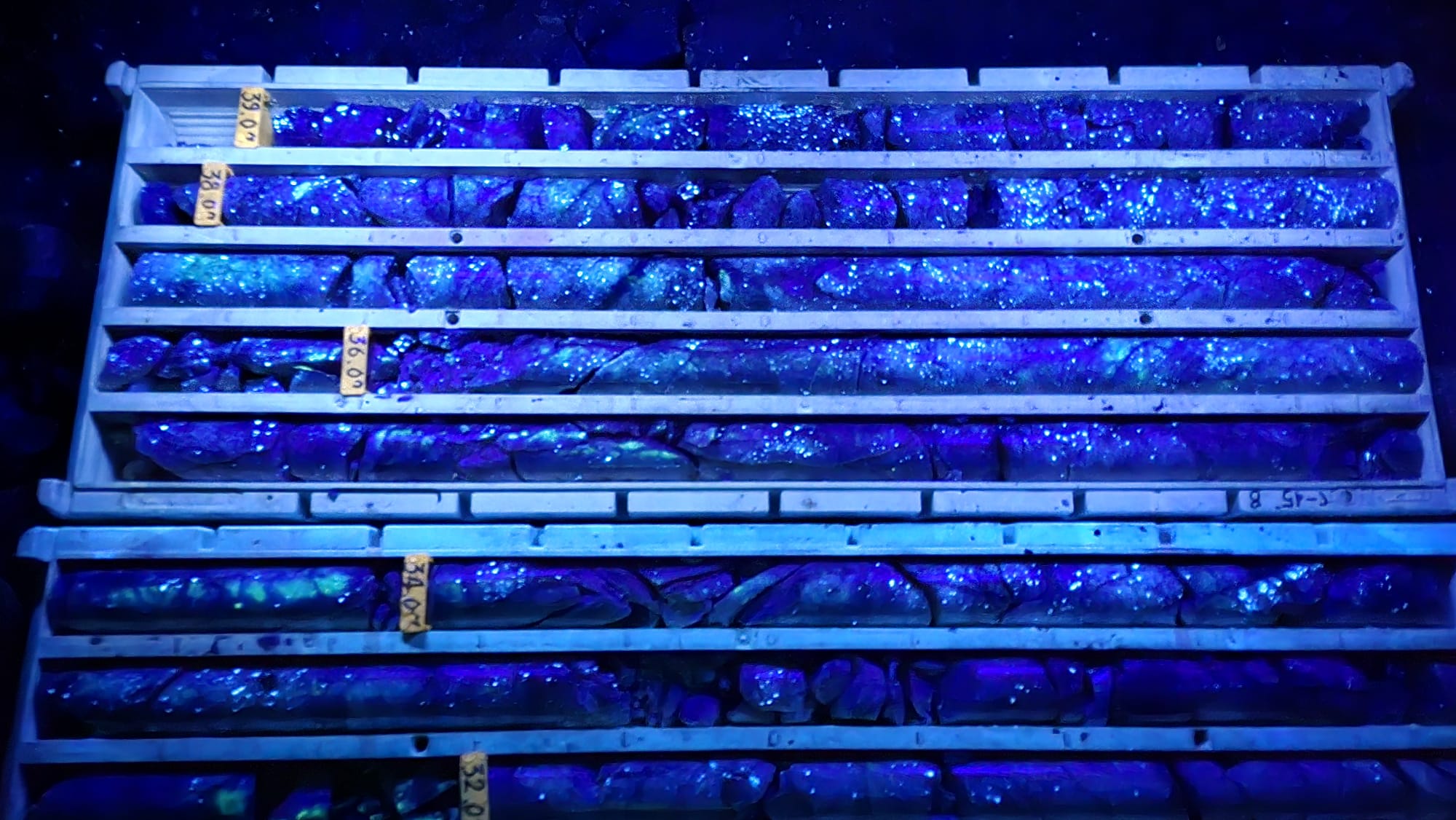
Pure Tungsten Inc. is developing non-Chinese tungsten supply from the Ssangjon mine in South Korea, where production is targeted for Q4 2026, and the Maykhura project in Tajikistan. Tungsten is mined mainly from two minerals, wolframite and scheelite, which glows blue under ultraviolet light, as in the drill core in the image above. For investment details, request the Pure Tungsten investor pack.